The Technology-First Home Health Agency: How to Grow Margin, Capacity, and Care When the Industry Is Being Squeezed
The country has never needed home health more. The economics have never punished it harder. The agencies that thrive in the next decade will not be the ones that work more hours — they will be the ones that stop paying people to do work a system should do.
Every day until 2030, ten thousand Americans turn sixty-five. Seven in ten of them will need long-term care at some point in their lives, and almost all of them want the same thing: to receive that care at home — in the kitchen where they raised their kids, in the bed they have slept in for forty years, near the window with the bird feeder. This is not sentimentality. It is the most important fact in American healthcare economics.
Because home is not just where patients want to be. It is where the country can afford to care for them. A semi-private nursing home room now runs a median of $9,581 a month — nearly $115,000 a year. A private room crosses $129,000. Meanwhile, Medicare spent $16 billion on home health for 2.7 million beneficiaries in 2024 — roughly $6,000 per person per year. For the enormous population of patients who can be safely served at home, home health delivers care people actually want at a fraction of the institutional cost. There is no version of America’s demographic future that works without it.
The paradox: record demand, and 4.3 million patients turned away
So here is the paradox that should keep every health policy person awake at night. Demand for home health is the strongest it has ever been — and the industry is turning patients away at the highest rate ever recorded.
The numbers are stark. Industry-wide, agencies received an estimated 11.9 million referrals in 2024. More than 4.2 million of those patients never made it into care. The referral-to-admission rate has fallen from about 74% before the PDGM payment model to roughly 64% today. In the most recent industry workforce report, 63.3% of home health providers said they are actively turning down referrals — and rejections attributed to staffing shortages are running at double the pre-pandemic rate.
Why? Because the operating model is buckling under three simultaneous pressures.
- Payment is tightening. CMS finalized a net 1.3% cut ($220 million) to home health payments for 2026 — after proposing 6.4% — and MedPAC has asked Congress for a further 7% base-rate reduction in 2027. Medicare Advantage, which typically pays less than traditional Medicare, keeps growing its share of the patient mix.
- The workforce is exhausted. Registered nurse turnover in home health stands at 25.46%; home health aide turnover is 34%. Turnover is concentrated among first-year clinicians, and nearly half of nurses with under ten years of experience report burnout. Every departure costs an agency real money in recruiting, onboarding, and lost continuity.
- Administration is eating the day. Home health clinicians spend an estimated 35–40% of their working time on documentation and administrative tasks. Intake teams spend 15–30 minutes manually re-keying every faxed referral. Coordinators spend afternoons calling physician offices about unsigned orders. None of this is care. All of it is payroll.
Read those three pressures together and you see the real problem: it is not that home health is a bad business. Freestanding agencies still posted a 21.2% Medicare fee-for-service margin in 2024. The problem is that the margin is leaking out through the operational seams — the faxes, the phone tag, the evening charting, the signature chase — and the payment environment no longer forgives the leaks.
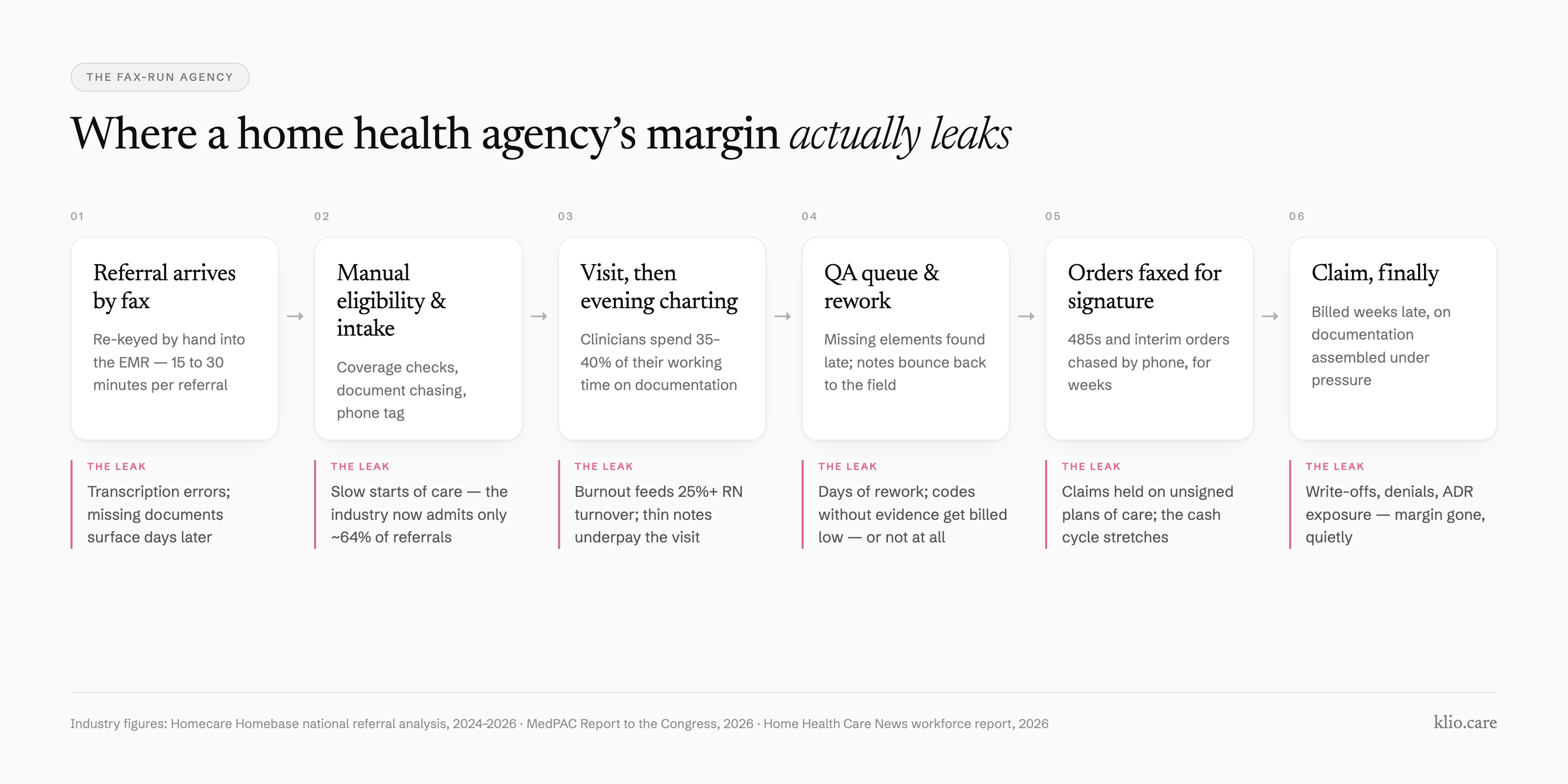
Walk the pipeline: where the money actually goes
Trace one referral through a traditional agency and count the invisible costs.
It starts as a fax. Somebody prints it, reads it, and re-types the demographics, diagnoses, insurance, and physician information into the EMR — fifteen to thirty minutes of skilled labor per referral, with a transcription error rate that guarantees some of those minutes were spent entering the wrong policy number. Then eligibility: a coordinator logs into payer portals or waits on hold to confirm coverage. Then the document chase — the face-to-face encounter note is missing, the med list is stale, the office phone rings unanswered. Days pass. In an industry where CMS now requires every agency to maintain a formal acceptance-to-service policy precisely because referral delays became a federal concern, days matter.
Then the nurse visits — and the second shift begins. The assessment that took an hour in the home takes another hour to document at the kitchen table that night. Multiply by five visits a day, five days a week, and you understand why documentation burden shows up in every exit interview. Under-slept nurses write thin notes; thin notes miss the clinical detail that justifies accurate coding; and the agency quietly bills below the acuity of the care it actually delivered.
Then QA finds the gaps — a week later, when the nurse no longer remembers the visit and the episode clock is running. Then the 485 goes out for signature by fax, and a coordinator starts the polite-rotation phone calls, because the claim cannot drop until the plan of care is signed. By the time the payment arrives, the agency has spent coordinator hours, nurse evenings, QA rework cycles, and weeks of float on a single episode — and surrendered revenue at every checkpoint along the way.
The alternative is not working harder. It is a different operating loop.
Now walk the same referral through an agency that runs technology-first — the way more than a hundred agencies already run on Klio Care.
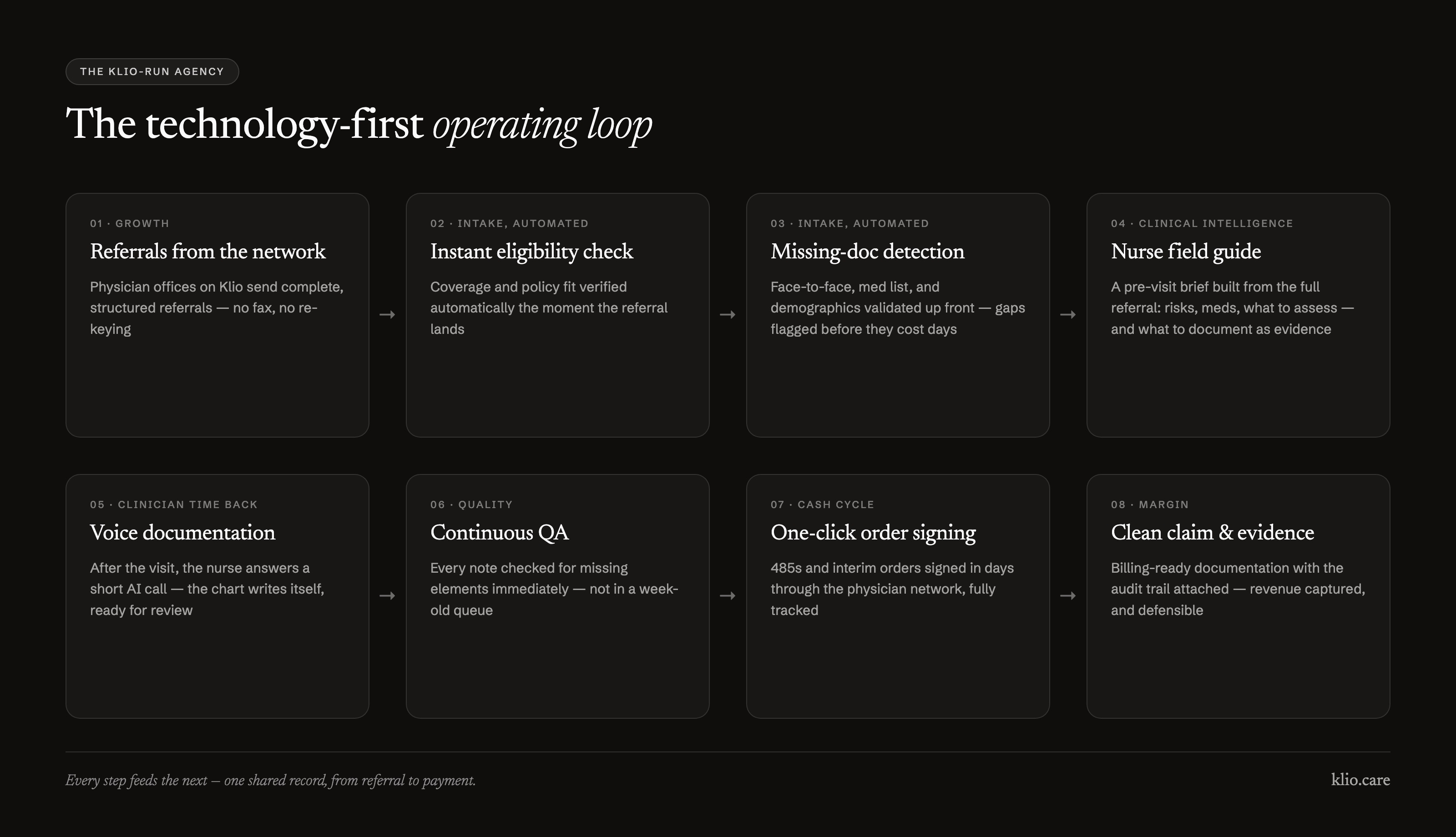
1. Referrals arrive structured — from a network, not a fax machine
Klio works with physician offices directly: they use it to send home health referrals, track patients, and document their own G0179 / G0180 certifications for accurate billing. That means when an office on the network refers to your agency, the referral arrives as structured data with the documentation attached, not as a fax to be deciphered. Nobody re-keys anything. And because the physician side gets real value from the platform, your agency becomes the easiest one in the market to refer to — which is how technology quietly becomes a growth engine, not just a cost saver.
2. Eligibility and missing documents are checked in seconds, not shifts
The moment a referral lands, Klio runs the checks your intake team used to run by hand: coverage verification against the payer, fit against your acceptance-to-service policy, and a completeness sweep of the packet — face-to-face note, med list, demographics, physician enrollment. Within minutes you have a clear report: this patient is eligible, this is what is missing, this is who to ask. The intake decision that used to take a day of portal-hopping and phone tag happens while the referral is still warm.
This is not about eliminating your intake people. It is about eliminating the part of their day that a machine does better, so the humans handle judgment — the complex cases, the family conversations, the referral relationships.
3. Every visit starts with a field guide — and a revenue intelligence layer
Before the start-of-care visit, Klio reads the full referral package and generates a field guide for the nurse: this patient’s risk factors, current medications and interactions to verify, wounds and conditions to assess, and — critically — the clinical evidence that should be documented if it is present. This is the piece most agencies never had: a revenue intelligence layer that connects what the nurse observes to what the agency can accurately and defensibly bill.
The distinction matters. Upcoding is fraud. But downcoding — delivering complex care and billing it as simple care because the note never captured the complexity — is the default state of an exhausted workforce, and it costs agencies real percentage points of revenue every year. When the nurse knows before the visit which observations matter, the documentation supports the code that reflects the care actually given. Accurate, evidenced, audit-ready.
4. The chart writes itself — the nurse just answers a phone call
After the visit, the nurse gets a short call from Klio’s AI voice agent. It asks the questions a great QA reviewer would ask — what did you find, what changed, what did you teach, what are the wound measurements — and the nurse answers in plain speech, driving between visits or standing in a parking lot. The system drafts the visit documentation and pushes it into the chart for the nurse’s review and sign-off.
Industry studies of AI-assisted documentation show 30–50% reductions in time-to-complete for visit notes. For a clinician spending 35–40% of working time on documentation, that is one to two hours returned every single day. Those hours become another visit of capacity, or they become an evening at home — and in a workforce where a quarter of nurses leave every year, an evening at home is a retention strategy with a hard dollar value.
5. QA runs continuously, and orders sign themselves out the door
Because documentation is structured from the start, quality assurance stops being a queue and becomes a filter: every note is checked for missing elements immediately, while the visit is fresh, instead of surfacing a week later as rework. Clean documentation flows straight into the billing report.
And the last mile — the one that strangles most agencies’ cash flow — disappears almost entirely. The 485 and every interim order route through Klio to the physician’s own signing queue, with automated reminders and full status visibility. Orders that took two to four weeks of chasing come back signed in days, with a timestamped audit trail attached. The claim drops when the care is done, not when the fax pile clears.
The math: what this is worth to a real agency
Let’s put honest numbers on it. Take a mid-size agency: roughly $2.5 million in annual revenue across about 1,200 thirty-day payment periods, running a typical 12% all-payer operating margin — about $300,000 a year. Here is what each lever in the loop is worth, with the assumptions stated so you can argue with them.
- Documentation integrity: If field guides and evidence-linked documentation lift average revenue per period by just $120 — well under the gap most coding reviews find between care delivered and care billed — that is roughly $144,000 a year, or 5.9 points of margin.
- Intake automation: Instant eligibility and missing-doc detection absorb most of a manual intake workload (15–30 minutes per referral across every referral you receive, admitted or not) and shorten time-to-start-of-care. Conservatively $55,000 a year in labor and captured admissions — 2.2 points.
- Clinician capacity and retention: Voice documentation returning 1–2 hours per clinician per day means more visits per FTE, less paid overtime, and fewer resignations in a market where replacing one home health RN costs tens of thousands of dollars. Valued conservatively at $110,000 — 4.5 points.
- Faster signatures: Orders signed in days instead of weeks means claims release sooner, aging write-offs shrink, and nobody is paid to chase faxes. About $35,000 — 1.4 points.
- Cleaner claims: Continuous QA and complete audit trails cut denials and ADR losses. About $30,000 — 1.2 points.
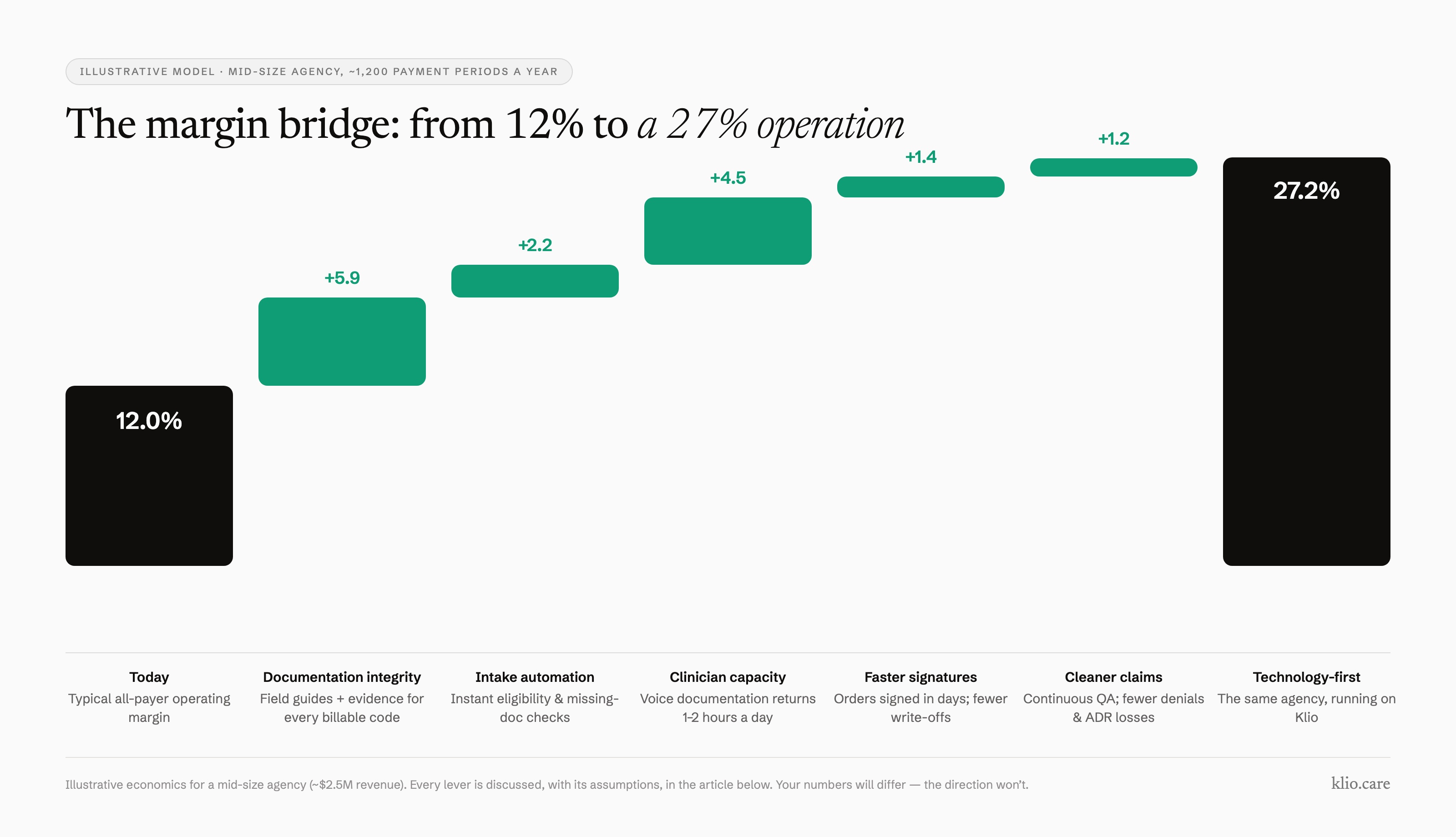
Add it up and the same agency — same patients, same clinicians, same payer mix — is running at roughly 27% instead of 12%. That is not a projection we ask you to take on faith; it is an arithmetic consequence of removing specific, measurable waste. Your numbers will differ. An agency doing $8 million will see bigger absolute gains; a smaller agency will feel the intake and signature levers first. But the direction is not in dispute, because every line item above is a cost you are already paying or revenue you are already earning and failing to collect.
And notice what this margin buys beyond profit: capacity. The agency that gets its clinicians’ evenings back and its intake decisions down to minutes is the agency that stops turning referrals away — in a market where 4.3 million patients a year cannot find care. Running a technology-first agency is not just the profitable choice. It is the one that serves more of the patients this country is aging into.
Why now — and why the fax-run agency does not survive the decade
Every force in the industry is compounding in the same direction. Payment rates are flat-to-down while wages rise. Medicare Advantage keeps growing, with tighter authorizations and thinner rates. CMS now regulates referral acceptance itself. Surveyors expect documentation trails that fax machines cannot produce. And the labor market has permanently repriced clinical time — which means an operating model that spends 35–40% of that time on paperwork is not a tradition, it is a liability.
The agencies that posted strong margins for two decades did it in a payment environment that absorbed operational waste. That environment is gone. What replaces it rewards exactly one thing: agencies that deliver more care per dollar of overhead. That is a technology problem, and it has a technology answer.
You do not need to build any of this. You need to switch it on.
Here is the part that surprises most administrators: adopting this loop does not mean an IT project, a rip-and-replace of your EMR, or a seven-figure line item. Klio sits alongside the EMR you already run — Axxess, Homecare Homebase, WellSky, MatrixCare — and takes over the coordination layer: referrals in, eligibility checks, field guides, voice documentation, QA, order signing, billing readiness. Physician offices get their own product on the same network, which is why they actually use it. More than a hundred agencies already run on it.
Think about what the alternative costs. Replicating this capability with people means another intake coordinator, another QA nurse, another order-chasing role — $150,000 to $250,000 a year in salaries to approximate, slowly and imperfectly, what the platform does natively. Klio Care delivers the technology-first operating loop at a fraction of that cost, and it starts paying for itself with the first cohort of orders that come back signed in days instead of weeks.
Bring us your numbers. In a 30-minute demo, we will walk your actual pipeline — your referral volume, your unsigned-order aging, your documentation turnaround — and show you, lever by lever, what the margin bridge looks like for your agency specifically. No slideware, no vague AI promises. Just your operation, run the way the best agencies in the country are already running theirs.
Frequently asked questions
Are home health agencies profitable?
Yes — freestanding agencies posted a 21.2% Medicare fee-for-service margin in 2024 — but all-payer margins are far thinner once Medicare Advantage and operating waste are included, and CMS cut 2026 payments by a net 1.3% with more proposed. Profitability increasingly depends on operational efficiency: agencies that automate intake, documentation, QA, and order signing keep several points of margin that fax-run agencies lose.
How can a home health agency increase its profit margin?
The five highest-leverage moves are: document to the true acuity of care with evidence (most agencies underbill), automate intake and eligibility checks, give clinicians back the 35–40% of their time lost to documentation, get physician orders signed in days instead of weeks so claims release sooner, and cut denials with continuous QA. Together these levers are worth roughly 10–15 points of margin for a typical mid-size agency.
How is AI used in home health care?
The proven applications in 2026 are administrative, not clinical decision-making: AI voice agents that draft visit documentation from a short conversation with the nurse (studies show 30–50% faster note completion), automated referral intake and eligibility verification, pre-visit field guides generated from referral documents, and continuous QA that flags missing documentation elements immediately. Clinicians review and sign everything.
Why are home health agencies turning away referrals?
Staffing and economics. Industry data shows referral-to-admission rates fell from about 74% before PDGM to roughly 64% today, with 63.3% of providers actively declining referrals and 4.3 million patients turned away annually. Agencies that automate administrative work effectively add clinical capacity without hiring, which lets them accept referrals competitors decline.
Does Klio replace our EMR?
No. Your EMR remains the system of record. Klio is the coordination and intelligence layer that runs alongside it — structured referrals from physician offices, instant eligibility and missing-document checks, nurse field guides, AI voice documentation, continuous QA, electronic order signing with physicians, and billing-ready reporting.
What does it cost to run a technology-first agency with Klio?
A fraction of the alternative. Replicating the same capability with staff means $150,000–$250,000 a year in additional salaries. Klio delivers the full operating loop for far less, and the platform typically pays for itself within the first cohort of faster-signed orders and cleaner claims. Book a demo and we will model the economics on your agency’s own numbers.
How physician offices scale referral volume without adding headcount
Read article→RevenueWhy home-health cash flow improves when orders stop sitting unsigned
Read article→Sign orders in seconds — with audit-ready documentation for every G0179 / G0180 you bill.
Starts at $100 / month for physician offices · No setup fees